
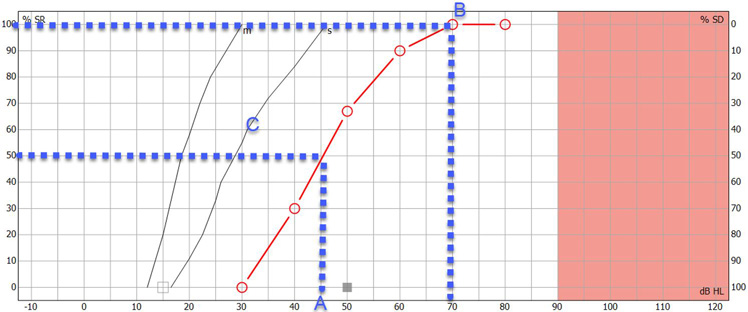
When you think of a traditional hearing test, you probably picture sitting in a quiet room, wearing a pair of headphones, and pressing a button every time you hear a faint “beep.”
This is called pure-tone audiometry. It’s a fantastic tool that maps out the absolute quietest sounds you can hear at different pitches. But while it tells us if you can hear a sound, it doesn’t tell us how well you actually understand what is being said.
That is where speech audiometry comes in.
If you have ever found yourself saying, “I can hear people talking, I just can’t understand the words,” this specific test holds the answers you’ve been looking for.
What is Speech Audiometry?
Speech audiometry is a core component of a comprehensive hearing assessment at audiology clinics. Instead of listening to electronic tones, you listen to recorded or spoken words at various volumes.
While pure-tone testing measures the physical sensitivity of your ears, speech audiometry measures how effectively your brain processes those sounds into meaningful language. Think of your ears as the microphones and your brain as the computer processor—speech audiometry evaluates the whole system together.
The Two Main Things We Measure
During this part of your evaluation, our audiologists look at two critical markers:
- Speech Recognition Threshold (SRT): This determines the softest, lowest volume level at which you can reliably repeat common, two-syllable words. It acts as a great baseline to verify the accuracy of your pure-tone test.
- Word Recognition Score (WRS): This is where we look at clarity. We play a list of words at a comfortable, easily audible volume and measure the percentage of words you repeat correctly. If you score an 80%, it means that even when a sound is perfectly loud enough, your brain is missing about 20% of the speech details due to clarity loss.
Why is This Test So Important?
Speech audiometry provides the “real-world” data we need to truly help you. Here is why it is an essential step in your hearing journey:
-
It Mimics Real Life: You don’t live your life listening to pure tones; you live it talking to grandkids, sitting in meetings, and catching up with friends at noisy Melbourne cafes.
-
It Explains the “Clarity vs. Volume” Puzzle: Many people experience high-frequency hearing loss. This means you can hear the low-pitched vowel sounds (making everything sound loud enough), but you miss the high-pitched consonants like s, t, th, or f. Speech audiometry quantifies exactly how much of this distortion is happening.
-
It Predicts Hearing Aid Success: If your word recognition score is quite high, it tells us that simply amplifying the sound with a hearing aid will yield excellent, clear results. If your score is lower, it tells us your brain needs a bit more help filtering out background noise, which guides us to select hearing aids with advanced speech-isolation technology.
What to Expect During the Test
There is absolutely nothing to worry or feel anxious about. The process is entirely stress-free and straightforward:
-
You will wear comfortable headphones or inserts inside a quiet room.
-
A series of words will be played or spoken by your audiologist.
-
All you have to do is repeat the words back as best as you can.
-
Even if a word sounds faint or a bit blurry, we always encourage you to take a guess!
Ready to Find Your Clarity Again?
Hearing health isn’t just about making the world louder; it’s about staying connected to the conversations that matter most. If you are struggling to follow along in groups, or feel like people are constantly mumbling, it’s time to get a complete picture of your hearing.
→ Book a Comprehensive Hearing Assessment with AudioHearing Melbourne today.
Let’s look beyond the beeps and get you back to hearing with confidence.
Recent Comments