
Have you ever found yourself turning up the television volume until the rest of the house complains? Or maybe you’re perfectly fine chatting one-on-one in a quiet room, but the second you step into a bustling Melbourne café, the wall of background noise turns your friend’s voice into a blur.
If this sounds familiar, you aren’t alone. While traditional hearing aids are incredible “all-rounder” companions for everyday life, there are specific, tricky environments where we need a bit of extra help.
That is exactly where Assistive Listening Devices (ALDs) step in.
What Exactly is an Assistive Listening Device?
Think of a traditional hearing aid as your general companion—it sits in or behind your ear all day, capturing and processing the entire soundscape around you.
An Assistive Listening Device (ALD), on the other hand, is a specialist. It is designed to solve a specific listening problem in a specific environment. Instead of just amplifying everything in the room, an ALD acts like a shortcut, picking up the exact sound you want to hear (like a speaker’s voice or your TV audio) and delivering it directly to your ears or your existing hearing aids.
The Best Part: ALDs can be used as standalone tools if you have mild hearing challenges but aren’t ready for hearing aids yet, or they can partner beautifully with your current hearing aids to give them a supercharged boost.
4 Common Types of ALDs That Make Life Easier
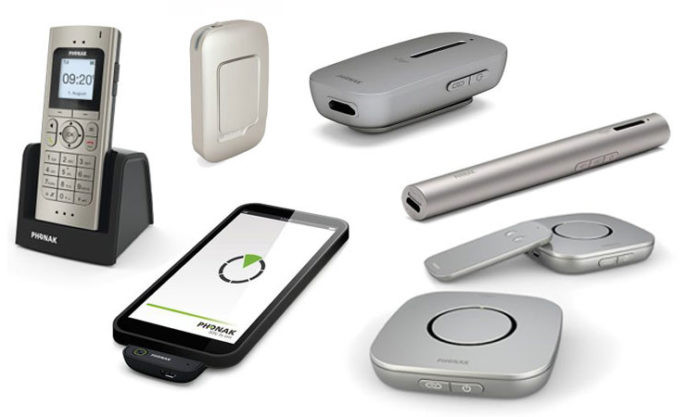
Technology has come a long way, and today’s ALDs are sleek, user-friendly, and incredibly effective. Here are the most popular devices people use to stay connected:
1. TV Streamers and Bluetooth Adapters
If you struggle to catch dialogue on your favorite shows, a TV streamer is a game-changer. It plugs directly into your television and wirelessly beams the audio straight to your headphones or compatible Bluetooth hearing aids. You get crystal-clear, personalized volume, while the rest of the family can keep the TV at a comfortable level for them.
2. Remote Microphones
Noisy restaurants, family dinners, or workplace meetings can be a nightmare for speech clarity. A remote microphone is a small, discreet device that you place in the middle of a table or ask a speaker to clip onto their shirt. It captures their voice directly, bypasses the ambient chatter of the room, and transmits it right into your ears.
3. Induction Loops and FM Systems
Ever noticed a small “Ear” symbol at a local theater, church, or community hall? That indicates an Induction Loop System. If your hearing device has a built-in feature called a telecoil (or T-coil), it can automatically connect to these public loops. The system takes the sound from the venue’s main microphone and broadcasts it magnetically to your hearing aids, cutting out the echo of a large room.
4. Alerting Devices
ALDs aren’t just about conversation—they are also about safety and independence at home. Alerting devices use flashing lights, loud tones, or gentle vibrations to let you know when the doorbell is ringing, the phone is buzzing, or a smoke alarm is going off.
Do You Need a Hearing Aid, an ALD, or Both?
Choosing the right technology comes down to your personal lifestyle and the unique blueprint of your hearing.
| If You Experience This… | …An ALD Might Be Perfect | …A Hearing Aid May Be Better |
| You only struggle in very specific moments (like watching TV or driving). | Yes (Great standalone fix) | Not always necessary yet. |
| You find yourself asking people to repeat themselves all day long. | Not enough on its own. | Yes (For continuous, all-day support) |
| You already wear hearing aids but still struggle in crowded places. | Yes (The ultimate companion tool) | You have the foundation, you just need a boost! |
Ready to Find Your Perfect Match?
The world of hearing technology moves fast, and there is no one-size-fits-all answer. The best way to cut through the confusion is to speak with a professional who can assess your hearing and look at your daily routine.
Whether you want to enjoy your grandkids’ voices without straining, follow a movie effortlessly, or simply feel safer at home, our expert audiology team at AudioHearing Melbourne is here to help.
→ Book a consultation with one of our friendly audiologists today
Let’s find the technology that fits your life perfectly.