
When you visit AudioHearing Melbourne for a hearing check, the journey to clearer hearing almost always begins with a pure-tone air conduction test. This is the standard, foundational hearing assessment used by audiologists worldwide to precisely measure how well you hear different frequencies of sound.
If you have ever wondered what happens during this test and why it is so critical, here is a clear breakdown of what you need to know.
What is a Pure-Tone Air Conduction Test?
Air conduction refers to the natural path that sound waves travel through the air, into your outer ear canal, across the eardrum, through the middle ear bones, and finally into the inner ear (cochlea) where the brain processes it.
The test determines the faintest sounds you can hear at various pitches (frequencies), ranging from low bass tones to high treble clicks.
What to Expect During the Test
The procedure is entirely non-invasive, completely painless, and typically takes less than 20 minutes:
- The Setup: You will sit in a quiet, sound-treated room or booth to block out background noise and put on a pair of comfortable headphones or soft insert earphones.
- The Tones: Your audiologist will play a series of tones at different pitches, one ear at a time.
- Your Response: Every time you hear a tone—even if it sounds incredibly faint or distant—you will signal the audiologist by pressing a button or raising your hand.
- Finding the Threshold: The audiologist will gradually lower the volume of each pitch until you can no longer hear it, identifying your exact “hearing threshold” for that specific frequency.
Reading the Results: Your Audiogram
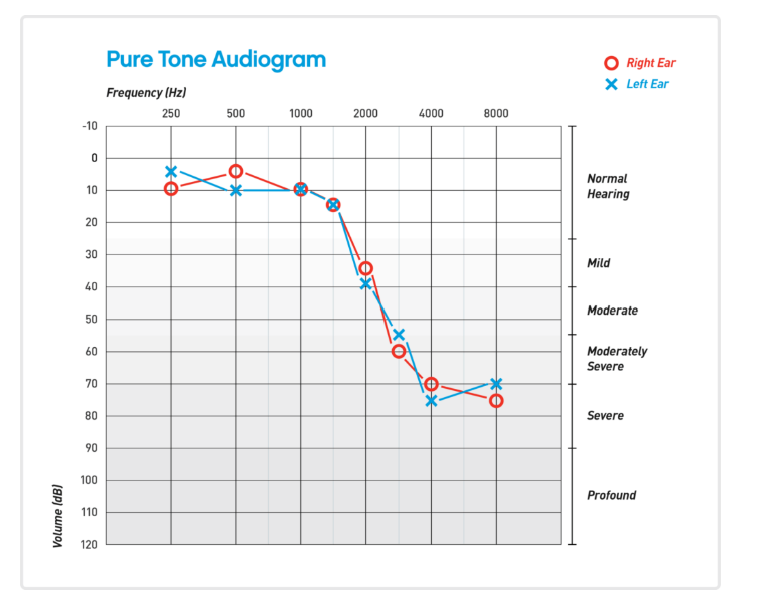
The thresholds mapped during this test are plotted on a graph called an audiogram.
-
The Vertical Axis measures sound volume in decibels (dB), ranging from very soft at the top to very loud at the bottom.
-
The Horizontal Axis measures sound pitch in Hertz (Hz), tracking from low frequencies (like a low hum) to high frequencies (like a bird chirping or a child’s voice).
Your air conduction results are marked with specific symbols (usually a red ‘O’ for the right ear and a blue ‘X’ for the left ear). This visual blueprint allows your audiologist to see exactly where your hearing is strong and where it might need support.
Why It Matters
A pure-tone air conduction test does not just determine if you have hearing loss—it determines the precise degree (mild, moderate, severe) and configuration (such as high-frequency vs. flat hearing loss) of your unique hearing profile.
Armed with this accurate data, our audiologists at AudioHearing Melbourne can uniquely tailor solutions—whether that involves lifestyle recommendations or programming advanced digital hearing technology—to perfectly match your day-to-day communication needs.
Ready to check your hearing health?
→ Contact AudioHearing Melbourne today to schedule your comprehensive hearing assessment and take the first step toward clearer conversation.