
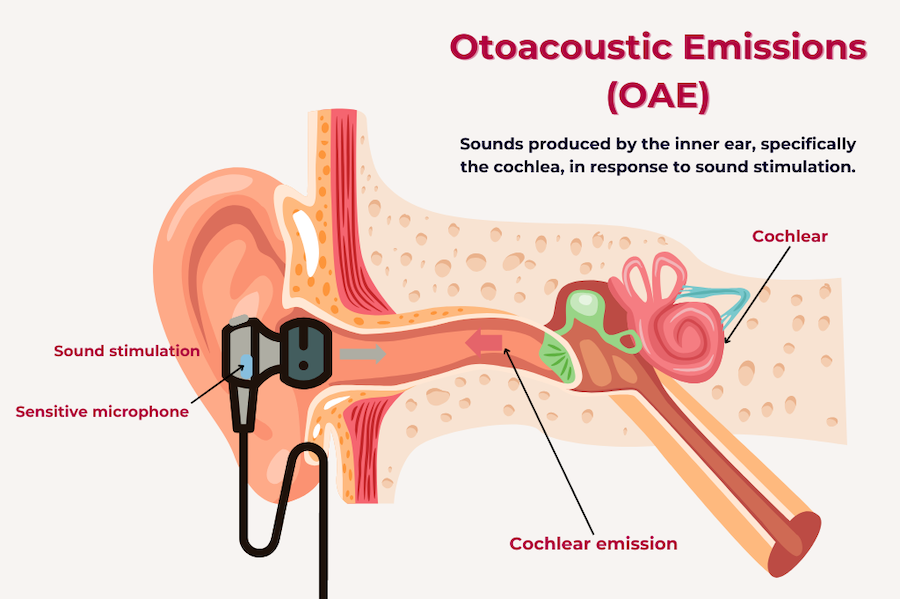
How Your Ears Produce Their Own Sound
When we think about hearing, we usually think about how our ears receive sound from the outside world. But did you know that a healthy inner ear actually produces its own microscopic sounds in response to external noise?
These sounds are called Otoacoustic Emissions (OAEs). In modern audiology, measuring these tiny echoes provides a quick, completely painless, and highly objective look at how well the inner ear is functioning.
What Exactly Are Otoacoustic Emissions?
Inside your inner ear lies a fluid-filled, spiral structure called the cochlea. The cochlea is lined with thousands of microscopic sensory cells known as outer hair cells (OHCs).
When a sound wave enters your ear, it vibrates the eardrum and the tiny bones of the middle ear, eventually reaching the cochlea. The outer hair cells respond to this movement by mechanically expanding and contracting. This movement acts like a built-in amplifier, sharpening and boosting the signal sent to the brain.
Remarkably, this mechanical energy doesn’t just travel forward to the brain—a small amount of it vibrates backward through the middle ear structures and out into the ear canal. This backward echo is an Otoacoustic Emission.
If the outer hair cells are healthy and functioning normally, they emit these echoes. If there is damage to the outer hair cells (due to noise exposure, certain medications, or genetic factors), the emissions disappear or diminish significantly.
How is an OAE Test Performed?
One of the greatest advantages of an OAE test is that it requires absolutely no active participation from the person being tested. You don’t need to raise your hand, push a button, or tell the clinician when you hear a sound.
Here is exactly what happens during a quick OAE evaluation:
- Probe Placement: A small, soft rubber tip is placed just inside the opening of the ear canal. This probe contains a miniature speaker to deliver sounds and a highly sensitive, low-noise internal microphone to record the echoes.
- Sound Stimulation: The speaker sends a series of gentle clicking sounds or pairs of pure tones into the ear canal.
- Echo Measurement: The microphone captures the tiny acoustic energy bouncing back from the cochlea. A digital signal processing system filters out background noise and analyzes the strength and frequency of the response.
The entire procedure takes only a few minutes per ear, is entirely non-invasive, and can even be completed while a patient is asleep.
Who Benefits Most from OAE Testing?
Because the test is completely objective and exceptionally fast, it is utilized across several critical areas of hearing healthcare:
-
Newborn Hearing Screenings: OAE testing is the standard global gold standard for screening infants. Because newborns cannot give verbal feedback, OAEs allow clinicians to instantly verify whether the cochlea is functioning properly within days of birth.
-
Pediatric Audiology: Toddlers and young children can find traditional behavioral hearing tests challenging. OAEs provide a reliable physical baseline of inner ear health without needing the child to follow complex instructions.
-
Industrial Noise Monitoring: Damage to the outer hair cells is often the very first sign of noise-induced hearing loss. Routine OAE screenings can spot early signs of cochlear fatigue in workers exposed to noisy environments long before that damage shows up on a standard behavioral audiogram.
-
Ototoxicity Monitoring: Certain lifesaving medications (such as specific chemotherapy drugs or heavy antibiotics) can be toxic to the ear. Regular OAE testing tracks inner ear health during medical treatments so physicians can adjust dosages before permanent hearing loss occurs.
A Crucial Piece of the Hearing Puzzle
It is important to note that while an OAE test provides vital data about the health of the cochlea, it does not measure hearing as a complete pathway. It won’t detect issues past the inner ear, such as auditory nerve problems or processing issues in the brain.
For a comprehensive evaluation, audiologists pair OAE testing with standard pure-tone audiometry and tympanometry. Together, these tests give a complete, three-dimensional view of your auditory system’s health.
Are you concerned about your hearing health or interested in advanced diagnostic assessments for your family? Contact the team at AudioHearing Melbourne today to book a comprehensive consultation with a professional clinical audiologist.